

You have taken thousands of notes. Lecture notes, meeting notes, book highlights, voice memos, sticky notes on your monitor. But when someone asks about something you wrote down six months ago, your mind goes blank.
That is not a memory problem. That is a system problem. And knowing the difference will change how you learn.
The Illusion of Capture
There is a quiet lie in modern note-taking: writing something down means you have learned it. However, science says otherwise.
Writing information down triggers what researchers call the encoding illusion. Basically, your brain thinks the effort of writing is the same as the effort of learning. It is not. So you close the notebook feeling good. But weeks later, the information is gone.
This is why students with long, detailed notes often do worse on exams than peers with shorter, more focused ones. Clearly, volume is not understanding. Similarly, storage is not knowledge.
The Forgetting Curve Is Not Your Enemy — Your Workflow Is
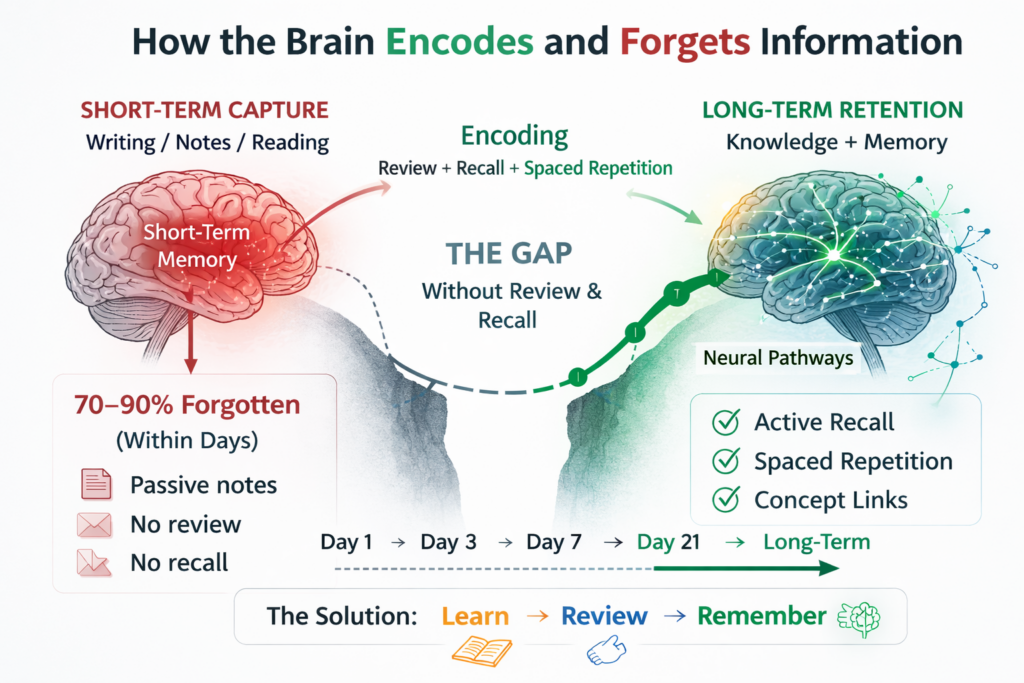
Hermann Ebbinghaus mapped the forgetting curve in the 1880s. Within 24 hours, we forget about 70% of new information. Within a week, that rises to nearly 90%.
Fortunately, the fix has been known for just as long: spaced repetition. You review information at set intervals — day 1, day 3, day 7, day 21. Each time, your brain holds it a little longer. Additionally, if you add active recall — testing yourself instead of just re-reading — the results are even stronger.
The science works. The problem, however, is that using it takes too much effort.
Tools like Anki ask you to create flashcards by hand. That means writing your notes twice — once to capture, once to convert. Most people skip the second step. As a result, the notes pile up and the knowledge fades.
Why “Second Brain” Systems Break Down
The 2010s were full of advice about building a personal knowledge management system — a “second brain” that stores everything you have ever read, thought, or written.
It sounded great. In practice, however, it became a chore.
These systems need constant upkeep: tagging, linking, sorting, and cleaning. For writers and researchers, that work pays off. For most people — students, busy professionals, curious readers — the system quickly becomes a guilt trip rather than a helpful tool.
There is also a bigger issue: a second brain that does not talk back is just a hard drive. Sorting your notes does not teach you anything. Moreover, a neat folder system does not move ideas into your long-term memory. In short, a static storage system, no matter how tidy, is not a learning system.
What AI Changes (When It Is Built Right)
AI can change the way we learn from notes. But only when it solves the right problem.
Most AI note tools today just summarise. They shorten your notes, pull out keywords, or suggest related files. While that is helpful, it is still just better storage. The real problem is not storage. Instead, the real problem is learning.
The best AI tools go further. They read what you have written and build a learning plan based on it — one made just for you. Here is what that looks like in practice:
- Adaptive learning sessions that focus on what you find hard, not what you already know
- Concept-level tracking that spots when you still have not grasped an idea, even after reading the note more than once
- Smart knowledge graphs that find links between your notes — even ones you would never spot yourself
- Easy capture that works with any format: typed text, scanned handwriting, photos, or hand-drawn diagrams — all turned into clean, structured notes
The difference is simple. Some AI tools work on your notes. The best ones, however, work for your learning. One is a smarter search bar. The other is a study partner.
The Knowledge Map Problem Nobody Talks About
Here is something most note apps ignore: your brain is very good at remembering where things are.
The method of loci — also called the memory palace — is one of the oldest memory tools we know of. You link ideas to places in your mind. Then you walk through those places to recall them. It works because spatial memory is one of our strongest natural abilities.
Yet most note apps ignore this entirely. Your notes sit in a flat list or a folder tree. These formats work well for computers. They do not, however, match how the human brain stores and finds things.
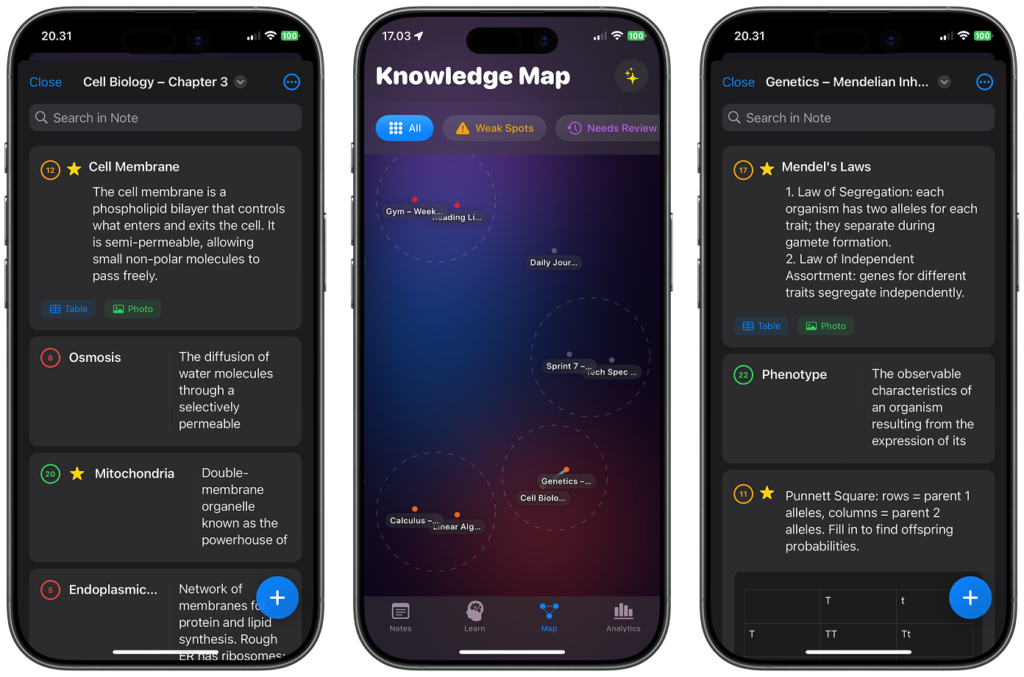
A visual knowledge map changes that. It shows your notes as dots on a map, with lines connecting related ideas. As a result, you can see the shape of your knowledge at a glance. More importantly, your memory has a place to anchor each idea.
When you can see that a note on focus links to a note on habit building, which in turn links to a note on sleep, something clicks. You have not just organised three topics. Instead, you have built a mental structure that makes all three easier to remember and use.
What This Means for Different Types of Learners
Students preparing for exams have an active recall problem more than anything else. Re-reading notes the night before feels productive. In reality, though, it mostly just triggers the encoding illusion again. What actually works is a system that has been testing you on the hard stuff for weeks before exam day.
Professionals in complex fields — law, medicine, tech, finance — face a different risk. For them, forgetting something does not mean a lower grade. Instead, it can mean a bad decision, a missed detail, or a mistake made because the right context was buried in old notes they could not find.
Lifelong learners who read across many topics will find that the knowledge map is not a bonus feature. It is the core feature. Seeing how ideas connect is what deep learning actually feels like. Therefore, tools that make those links visible are worth far more than tools that just file things neatly.
Three Principles That Separate Learning Systems from Storage Systems
Whatever tools you pick, these three rules split the systems that build real knowledge from the ones that just collect it.
First: make capture fast and review active. If saving a note takes more than ten seconds, you will stop doing it. Similarly, if reviewing means passive re-reading, you will not retain much. Both ends need to work well.
Second: your system should track what you do not know. A tool that treats every note the same is not a learning system. In other words, good knowledge management tracks mastery at the concept level, not just the file level.
Third: organise for retrieval, not for looks. A tidy folder system that falls apart under pressure is not useful. Instead, organise the way your brain works — by connection, by context, and by what feels related — not just by topic or date.
Where to Start
Note-taking tools are changing fast. As a result, the best ones are now closing the gap between writing something down and actually knowing it.
One app worth trying is Wisen — an iOS app built around learning, not just storage. You can write notes in a block-based editor, scan handwritten notes or documents, draw on a canvas, and organise everything into nested folders with drag and drop. Its AI reads your notes privately and builds learning sessions around them. Furthermore, it tracks which concepts you know well and which ones need more work. It also builds a visual knowledge map so you can see how your ideas connect. On top of that, it shows you your weak points with built-in analytics, and lets you pin notes to a location so you always remember where an idea came from.
It is, in short, one of the best examples of a note app built to help you actually learn — not just file things away.
If you found this useful, please share and read our earlier post How to Never Forget What You Write Down Again.
Your notes are only as useful as what you do with them. So build a system that does not stop at capture. Build one that holds you to actually knowing what you wrote.
The forgetting curve is real. Fortunately, it is not something you have to accept.
Leave a Reply