

Learning & Memory · March 2026 · 6 min read
Why Taking Notes Doesn’t Mean You’ll Actually Remember Anything
- The Gap Between Writing Notes and Remembering Information
- Why the Brain Forgets Notes So Quickly — The Forgetting Curve Explained
- The Fluency Illusion: Why Re-Reading Your Notes Feels Like Learning But Isn't
- The Real Problem With How Most People Take and Store Notes
- Digital Note-Taking Apps and the Storage Problem
- Wisen Turns Your Notes Into Study Sessions Automatically
Students, professionals, and lifelong learners all take notes. Yet almost all of them forget most of what they wrote within days. The problem isn’t the notes themselves. Rather, it’s what happens after you write them or more often, what doesn’t.
The Gap Between Writing Notes and Remembering Information
You sit in a lecture and take detailed notes. Then a week later, you can’t recall most of it. This isn’t unusual. Note-taking and memory retention are two separate things. In fact, most note-taking habits do almost nothing to connect them.
Writing something down gives you a record. However, it doesn’t give you the neural reinforcement that makes information stick. A notebook full of bullet points is a transcript. As a result, it doesn’t teach you anything on its own.
“Re-reading your own notes is one of the least effective study methods in existence — yet it’s what almost everyone does by default.” — Cognitive psychology research on learning strategies
Why the Brain Forgets Notes So Quickly — The Forgetting Curve Explained
Hermann Ebbinghaus studied memory in the 1880s. He produced what’s now called the forgetting curve. It shows how fast information leaves memory when nothing reinforces it. For anyone who relies on notes, the numbers are uncomfortable.
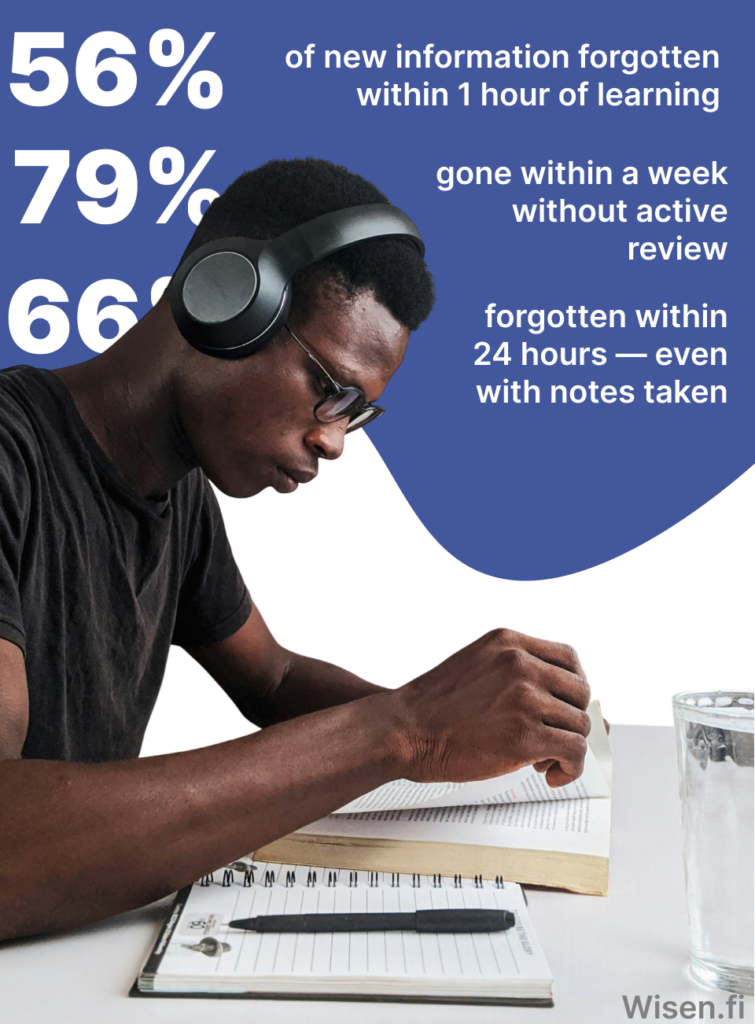
replicated by Murre & Dros (2015). Source: PLOS One — https://journals.plos.org/plosone/article?id=10.1371/journal.pone.0120644
The key phrase is without active review. The forgetting curve isn’t fixed. In fact, it flattens when you test yourself on material at the right intervals. That process is called spaced repetition. Furthermore, it’s one of the best-supported methods in learning science for building long-term memory.
However, most note-taking apps give you no mechanism for this. They store your notes — that’s it. Consequently, the work of spacing reviews and spotting gaps falls entirely on you. Most people never get around to it.
The Fluency Illusion: Why Re-Reading Your Notes Feels Like Learning But Isn’t
Many students re-read their notes and feel confident about the material. Psychologists call this the fluency illusion. Something feels familiar, so your brain assumes you understand it. In reality, you don’t.
Recognising words on a page is not the same as recalling what they mean. When you re-read a note, your brain fires a vague sense of familiarity. Then it interprets that feeling as competence. This is misleading. In contrast, only active recall — retrieving information without looking — builds real memory pathways.
The evidence has been consistent for decades. For example, testing yourself improves long-term retention far more than re-reading does. This is called the testing effect or retrieval practice effect. Importantly, it holds across all subjects and age groups.
The Real Problem With How Most People Take and Store Notes
Think about the typical pattern. You learn something, write notes, save them, then move on. A week later, the notes are still there. Your memory of the content, however, isn’t. Effectively, your notes become an archive of things you’re slowly forgetting.
The problem grows over time. More notes means harder navigation. Finding what’s relevant becomes a task in itself. As a result, most people with months of notes have no realistic way to study from them.
Motivation is also a factor. Re-reading feels low-effort. Moreover, it’s also low-reward — your brain gets little satisfaction because it isn’t being challenged. Creating flashcards manually takes too long. So the notes pile up, and reviewing never quite happens.
What Actually Works for Remembering Information from Notes
- Active recall practice — close your notes and answer questions from memory, then check your answers
- Spaced repetition review — revisit material at growing intervals (1 day, 3 days, 1 week, 2 weeks) before the memory fades
- Interleaved study — mix topics across a session; this feels harder but builds stronger retention
- Elaborative interrogation — ask “why” and “how” about facts in your notes to build richer memory traces
These methods work well. The issue, however, is that they need consistent effort and a system. Most note-taking tools make no attempt to provide either.
Digital Note-Taking Apps and the Storage Problem
Apps like Notion, Obsidian, Apple Notes, and Evernote have improved how people capture information. Search works. Syncing works. Tagging is easy. Despite these improvements, they share the same core problem: they store notes — they don’t help you learn from them.
Even the best-organised digital notebook is passive. It waits for you to return. Similarly, it won’t remind you that you haven’t looked at something in 30 days. In short, it holds your text and nothing more.
Some people add Anki on top of their workflow. In theory, this works. In practice, however, it takes significant extra time. The cards also fall out of sync with updated notes quickly. As a result, most people try it for a few weeks and give up.
The gap has been obvious for a while. What’s needed is a tool that combines note-taking with built-in study mechanics. In other words, something that makes memory retention part of writing — not a separate step you force yourself to do.
Wisen Turns Your Notes Into Study Sessions Automatically
Wisen is a note-taking and learning app. It’s built on a simple idea: notes should start studying, not end at storing. Anything you write, scan, or save can immediately become study material. Furthermore, there’s no manual flashcard creation and no separate app needed.
The app is built for people who already take notes regularly. Students, professionals, and self-learners all fit this description. In short, it’s for anyone who wants to retain information long-term — not just archive it.
Study from Any Note You’ve Ever Written
This is what sets Wisen apart. The AI reads your notes and builds active recall sessions from them. It asks questions, follows up on vague answers, and adapts to what you get right or wrong. Instead of choosing what to study, any note, any subject, any time — everything is fair game.
Scanned handwritten notes, typed book summaries, meeting notes from months ago — Wisen pulls any of it into a session. Moreover, it tests you using spaced repetition and active recall, not just re-reading.
- Scan handwritten notes, upload PDFs and images and turn them into clean, searchable text — great for students who write by hand
- AI-powered study sessions that ask questions from your actual content, track what you miss, and schedule reviews before you forget — not after
- Knowledge Map that shows connections between notes across subjects — surfacing links your brain might not make on its own
- Location tagging for notes — spatial context affects recall, and tying notes to where you wrote them adds another retrieval layer
- Private by design — AI analysis runs on your content only, with no data used for model training and no third-party sharing
Who It’s Actually Useful For
Wisen works for anyone who takes in information and wants to keep it. For instance, university students revising lecture notes will benefit immediately. So will language learners building vocabulary over time. Professionals who need to remember technical details also find it useful. In short, if you take notes but rarely go back to them — Wisen is built for you.
The common thread is simple: people who take notes but aren’t getting enough value from them. Wisen doesn’t change how you write. Instead, it picks up where note-taking stops and turns the storage problem into a study system.
Why This Matters for Long-Term Memory and Knowledge Retention
The tools that improve memory — spaced repetition, active recall, retrieval practice — are well understood. What’s been missing, however, is a simple way to apply them to everyday notes. Wisen removes that friction. As a result, the notes you were already writing become the input for a system that fights the forgetting curve.
Wisen doesn’t replace the work of learning. Rather, it makes sure the work you’re already doing — writing notes, capturing ideas — actually pays off.
Wisen is launching soon. Join the waitlist to get early access.
Please provide the image or specify the details for the featured image you would like to include.
Leave a Reply