

Learning & Memory · April 2026 · 11 min read
Many students, professionals, and lifelong learners face the same frustrating problem. They spend hours studying. They take detailed notes. However, a few days later, they struggle to remember what they studied.
This experience is extremely common. In fact, most people assume the problem is their memory or intelligence. However, research in learning science and cognitive psychology shows something different.
The real problem is usually the study method. In other words, the way we study often works against how memory actually functions.
Fortunately, modern research has identified several study techniques that dramatically improve knowledge retention and long-term memory. Once you understand how memory works, remembering what you study becomes far easier.
“People often mistake familiarity for understanding. However, recognition is not the same as recall.”
Cognitive psychology research on learning
Why Most People Forget What They Study
To begin with, most learners rely on passive study techniques. These techniques feel productive. However, they rarely create durable knowledge.
- Re-reading notes repeatedly
- Highlighting textbooks
- Watching lectures again
- Skimming summaries
At first glance, these methods seem effective. After all, the material becomes familiar. Nevertheless, familiarity is not the same as memory.
For example, you might recognize a concept when you see it in your notes. Yet when someone asks you to explain it without looking, the knowledge disappears.
This phenomenon is known as the fluency illusion. According to research published in Cognitive Psychology studies on retrieval practice, passive review often creates confidence without real learning.
Why Memory Disappears So Quickly
The reason behind forgetting was first studied by psychologist Hermann Ebbinghaus in the 19th century. His experiments revealed what is now known as the forgetting curve.
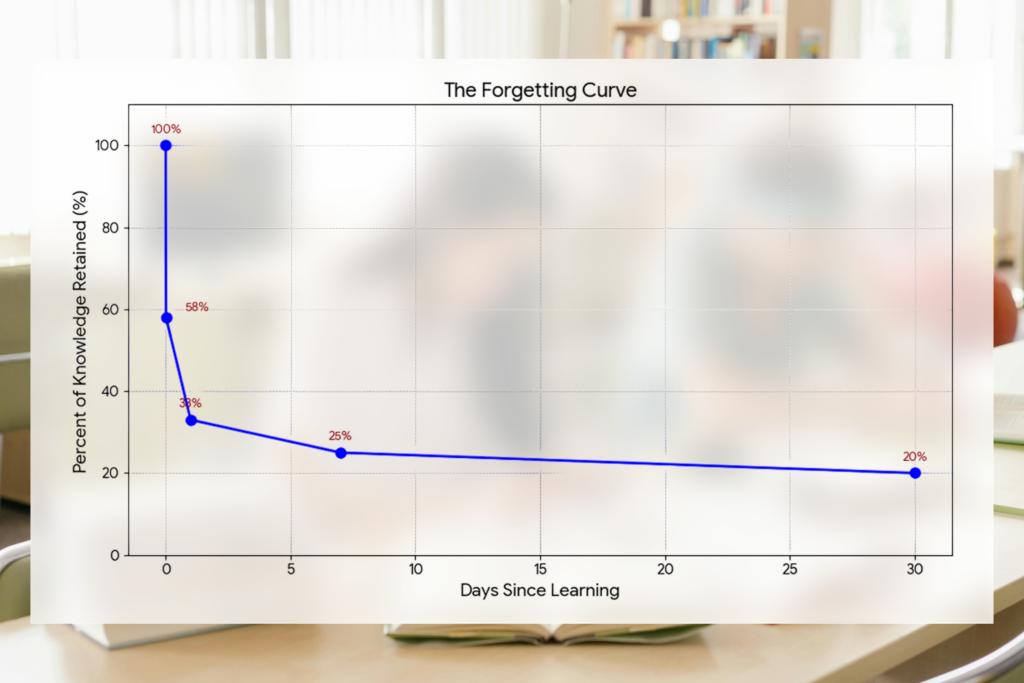
The forgetting curve shows how quickly information disappears from memory when it is not reinforced. Surprisingly, most newly learned information fades extremely fast.
| Time After Learning | Average Knowledge Retained |
|---|---|
| 20 minutes | ~58% |
| 1 day | ~33% |
| 1 week | ~25% |
| 1 month | ~20% |
Therefore, reading something once rarely leads to long-term learning. Without reinforcement, the brain simply removes information it considers unimportant.
Detailed analysis of the forgetting curve can be found in studies published in the National Library of Medicine, which demonstrate how repetition strengthens memory over time.
The Biggest Study Mistake Is Passive Review
Although passive review feels comfortable, it is one of the weakest learning strategies available. Reading notes repeatedly does not force the brain to retrieve information.
Instead, the brain simply recognizes the material. As a result, learners believe they understand the content.
However, real learning happens when the brain actively retrieves knowledge. Retrieval strengthens neural pathways and improves memory.
This is why students often perform poorly on exams even after hours of reviewing notes.
4 Study Methods That Actually Help You Remember
Fortunately, cognitive science has identified several study methods that consistently improve long-term learning.
1. Active Recall
Active recall involves retrieving information from memory without looking at your notes.
For example, you might close your notes and write down everything you remember about a topic. Alternatively, you might answer questions about the material.
Because this method forces retrieval, it dramatically improves memory strength.
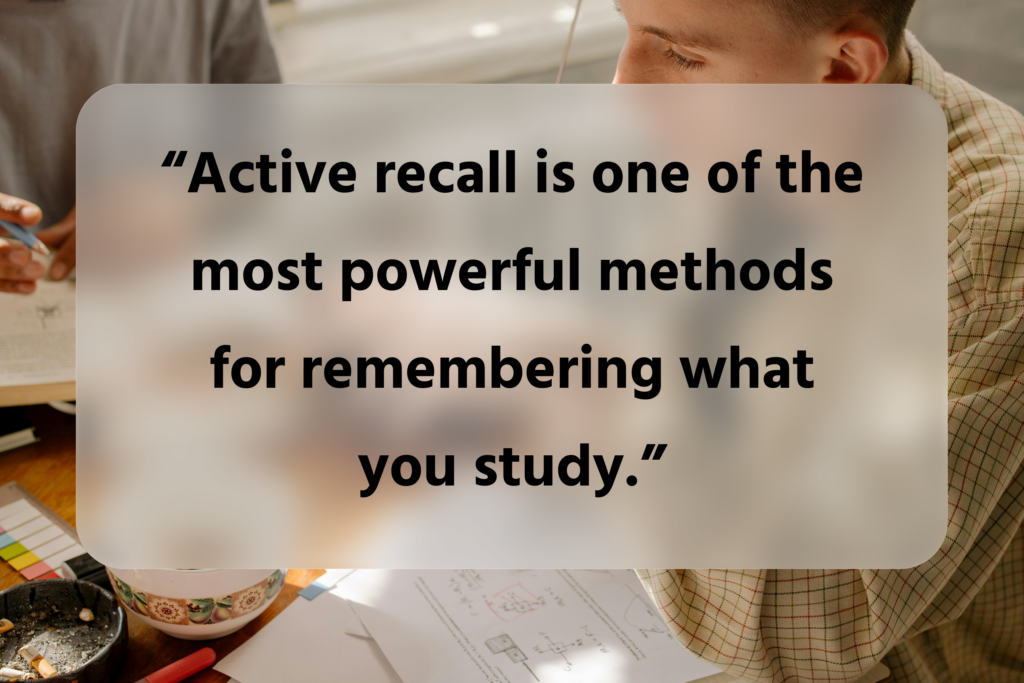
Studies published in learning science journals show that active recall can improve retention by more than 50% compared to passive review.
2. Spaced Repetition
Spaced repetition is another powerful learning technique. Instead of reviewing information immediately, you revisit it at increasing intervals.
For instance, you might review material after one day, then three days, then one week. Each review strengthens memory and slows forgetting.
Research summarized by Psychological Science shows that spaced learning dramatically improves knowledge retention compared to cramming.
3. Connecting Ideas
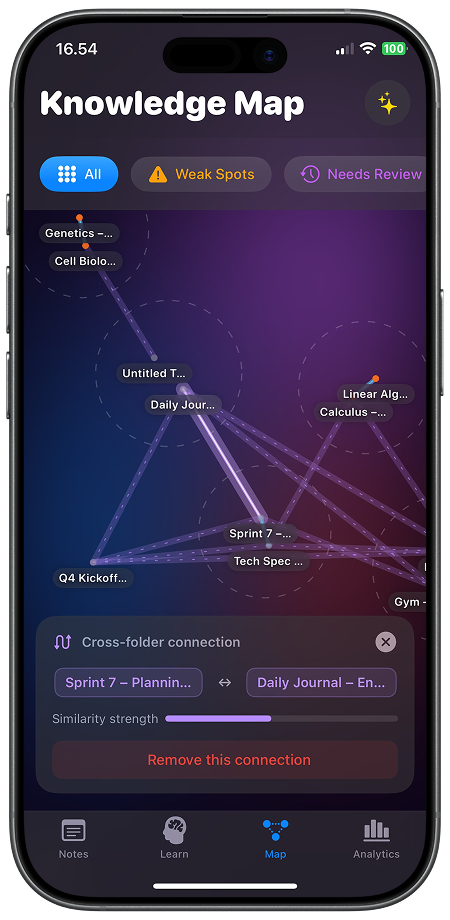
Memory works best when information is connected. Instead of storing isolated facts, the brain builds networks of ideas.
Therefore, linking concepts together helps strengthen understanding. When one idea appears, related ideas become easier to recall.
4. Testing Yourself Regularly
Another powerful technique is frequent self-testing. Even short quizzes significantly improve memory.
This phenomenon is known as the testing effect. Surprisingly, simply answering questions strengthens memory even if you answer incorrectly.
Consequently, retrieval practice has become one of the most recommended strategies in modern learning science.
Why Most Note-Taking Apps Still Fail at Learning
Today, millions of people use note-taking apps such as Notion, Evernote, and other digital tools.
These tools are excellent for organizing information. However, they are not designed for learning and memory retention.
Most note-taking apps focus on storing knowledge rather than helping users remember it. As a result, people accumulate thousands of notes that they rarely revisit.
Over time, the collection grows. Nevertheless, the knowledge inside those notes slowly fades.
How Wisen Helps You Remember What You Study
Wisen approaches note-taking differently. Instead of treating notes as static information, the system turns them into an active learning process.
Notes should not just store knowledge.
Instead, they should help you remember it.
Automatic Active Recall
First, Wisen converts your notes into questions. Consequently, every note becomes a potential learning session.
Instead of rereading information, you actively retrieve it. As a result, the knowledge becomes stronger each time you review it.
Spaced Learning From Your Notes
Second, the system schedules reviews automatically using spaced repetition.
Because the reviews appear just before forgetting occurs, the brain reinforces knowledge at the optimal time.
From Notes to Knowledge
Finally, Wisen turns passive note collections into a long-term knowledge system.
Instead of letting ideas disappear in old notes, you continuously revisit and strengthen them.
Therefore, learning gradually transforms from temporary information into lasting knowledge.
Leave a Reply