
Knowledge Systems · Personal Knowledge Management · 2026 · 14 min read
The idea of building a second brain has become extremely popular in recent years. In fact, interest in digital knowledge systems has grown dramatically as information overload increases.
Today, students, entrepreneurs, researchers, and creators are searching for better ways to organize ideas, store knowledge, and remember information more effectively.
As a result, millions of people now use tools designed to create a digital second brain.
However, many users eventually discover an unexpected problem.
Even when using the best second brain apps, notes often accumulate faster than they are used. Over time, the system becomes larger but not necessarily more useful.
Information gets stored easily. Meanwhile, ideas slowly fade from memory.
As a result, the “second brain” gradually turns into a knowledge archive instead of a thinking system.
Therefore, an important question emerges:
How do you build a second brain that actually helps you think, remember, and evolve ideas?
In this guide, we explore several important topics related to modern knowledge systems:
- what a second brain really is
- how personal knowledge management works
- how to build a second brain system step by step
- why many second brain apps fail over time
- how AI-powered systems are transforming knowledge management
Quick Summary: The Modern Second Brain System
A second brain system helps you capture, organize, and revisit knowledge outside your biological memory.
However, modern knowledge systems go much further. Instead of simply storing notes, they help users interact with ideas over time.
Effective digital second brain systems typically follow a few important principles:
- capture ideas quickly
- connect related concepts
- revisit knowledge regularly
- challenge your thinking
- allow ideas to evolve over time
Because of this shift, the best second brain apps are no longer simple note-taking tools.
Instead, they are gradually becoming AI-assisted knowledge systems that help people think more clearly and learn more effectively.
What Is a Second Brain?
The concept of a second brain refers to a digital system used to store and organize knowledge outside the human mind.
Rather than relying entirely on memory, people create a digital second brain where important information can be captured and revisited later.
For example, people commonly store:
- ideas
- insights
- research notes
- learning materials
- creative concepts
- personal reflections
This broader discipline is known as personal knowledge management (PKM).
A well-designed second brain system allows you to save information quickly while also retrieving it when needed.
- save information instantly
- connect ideas across topics
- retrieve insights later
- develop deeper understanding
However, storing information is only the first step. Ultimately, the most powerful second brain systems allow ideas to grow and evolve.
Why People Want a Second Brain
Modern life produces more information than any previous generation has experienced.
Every day, people encounter new ideas through books, podcasts, courses, research papers, and online media.
Without a reliable system to manage this knowledge, most insights disappear quickly.
Therefore, many people search for second brain apps because they want to:
- remember what they learn
- organize knowledge more clearly
- track ideas over long periods of time
- build deeper understanding
- improve clarity of thinking
In essence, a digital second brain acts as an extension of the human mind.
Consequently, knowledge can accumulate over time instead of disappearing.
The Hidden Problem With Most Second Brain Systems
At first glance, building a second brain system sounds extremely powerful.
However, many users eventually experience a frustrating reality.
Over time, their second brain becomes little more than a note archive.
Thousands of notes exist, yet very few are ever revisited.
This happens because many second brain apps prioritize organization rather than interaction.
| Traditional Second Brain | Active Knowledge System |
|---|---|
| Stores information | Revives knowledge |
| Organizes notes | Connects ideas |
| Passive archive | Active thinking system |
| Requires manual review | Resurfaces ideas automatically |
Manual vs Automatic Second Brain Systems
Most second brain systems available today still rely heavily on manual knowledge management.
Even when artificial intelligence is included, users typically perform most of the organizational work themselves.
For example, users must usually:
- organize notes manually
- review knowledge regularly
- create connections between ideas
- search for insights when needed
As a result, maintaining a second brain can become time-consuming.
Eventually, many people stop reviewing their notes because the system requires too much manual effort.
Wisen: An Automatic AI Second Brain
Most second brain apps focus primarily on storing knowledge.
In contrast, Wisen is designed as an automatic AI-powered second brain.
Instead of acting as a static note repository, the system actively interacts with your ideas.
Consequently, knowledge does not simply sit inside documents.
Instead, the system helps you:
- revisit forgotten ideas
- reflect on previous insights
- challenge assumptions
- connect concepts across time
- develop deeper thinking
Because of this design, knowledge can resurface automatically without constant manual organization.
Ultimately, the second brain becomes a living knowledge system rather than a static archive.
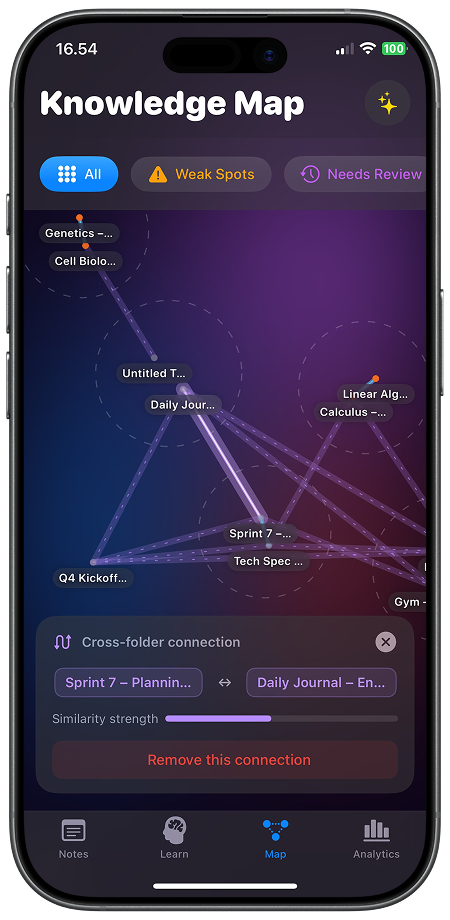
The real goal is not simply remembering information. Instead, the goal is helping ideas grow and evolve over time.
Final Thoughts
Building a second brain is one of the most powerful habits for lifelong learning.
However, the true value of a digital second brain is not just storing information.
Instead, the real value lies in interacting with ideas.
When knowledge systems help you revisit insights, connect concepts, and evolve thinking, your notes become significantly more valuable.
Ultimately, the system becomes something far more powerful: a knowledge network that grows together with your mind.
Want to Experience an Active Knowledge System?
Explore how Wisen turns notes into evolving knowledge.
Instead of static documents, your ideas become part of a living system that helps you remember, reflect, and think more deeply.
Learn more at wisen.fi
Leave a Reply