
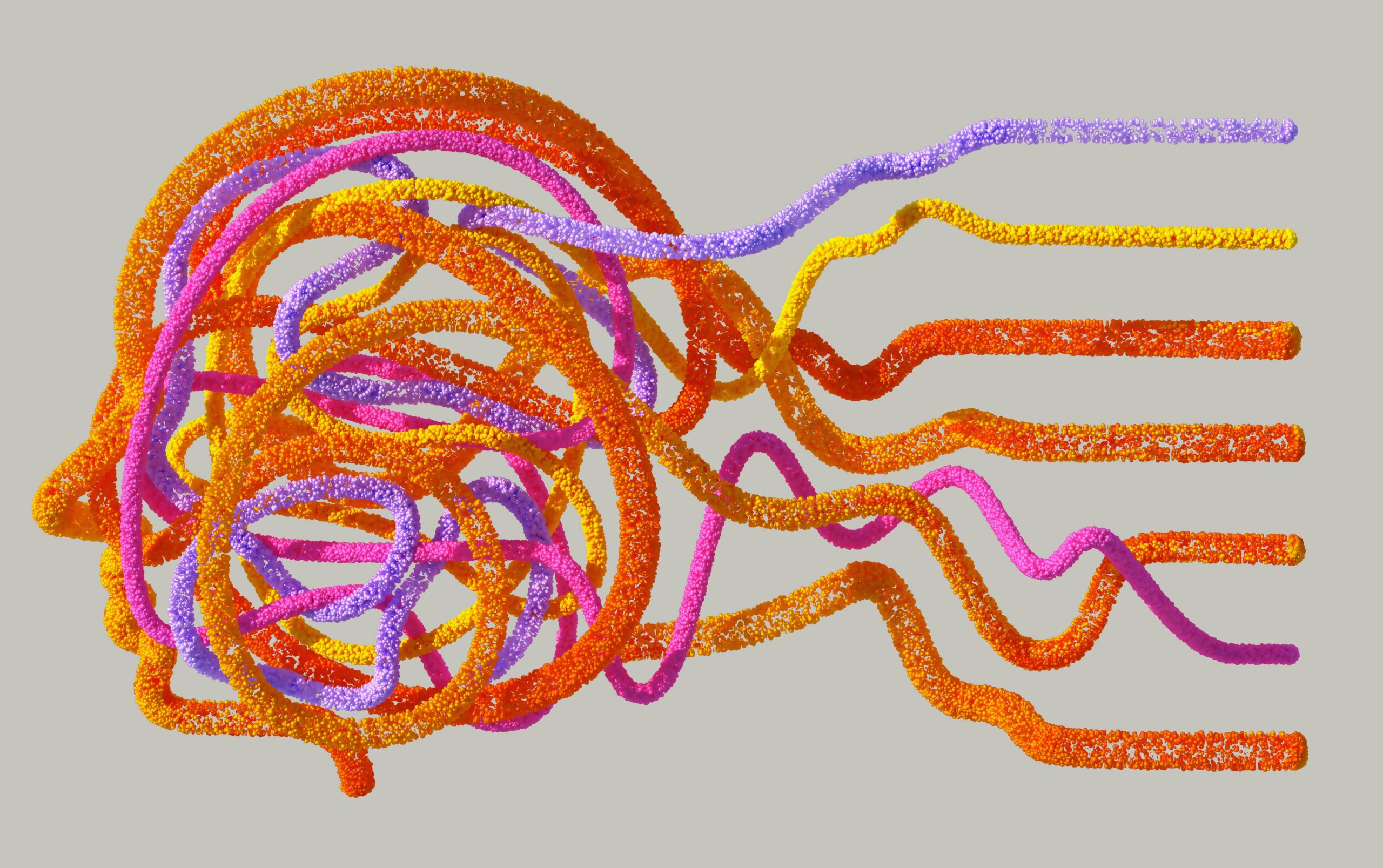
Why everything you’ve been taught about studying builds knowledge wrong — and what the science says.
There’s a version of this article that opens with a forgetting curve. Or a round number like “humans forget 70% of new knowledge within 24 hours.” You’ve seen that article. Chances are, you’ve forgotten it. This isn’t that. Instead, this is about something more uncomfortable. You may have been building your knowledge completely backwards. Not just badly — structurally wrong. The fix isn’t a new app. In fact, it’s a shift in how you think about knowledge itself.
The Myth of the Well-Organized Brain

Most of us learned to think of memory as a filing cabinet. Information comes in. You store it. Later, you pull it out. Clean and simple. Unfortunately, also wrong. Memory doesn’t work that way. What we call “remembering” is actually reconstruction. Your brain rebuilds a memory every time you access it. As a result, it pulls from many connected pathways at once — not just one stored file.
“Memory is not a recording device. It’s a living network. Every time you recall something, you’re not retrieving a file — you’re re-firing a web of associations.”
Think about hearing a song from your childhood. Suddenly you smell sunscreen. You feel a specific mood from years ago. That’s not one memory. It’s a cluster of linked experiences all firing at once. Therefore, the problem with most note-taking tools is structural. They’re still filing cabinets — linear, siloed, built for storage rather than thinking.
Why Isolated Notes Fail You
Here’s a situation most students know well. Picture 200 notes — tagged, color-coded, sorted into folders. Before an exam, you open the app and stare at them. Nothing. The knowledge is technically there. However, it doesn’t feel alive. It won’t come when you need it most.
That feeling has a name: inert knowledge. It’s information you have but can’t use. It was never linked to what you already know. It just floats in isolation. The gap between inert and usable knowledge isn’t about how much you know. Rather, it’s about how well your knowledge is connected. Experts don’t know more facts than beginners. Instead, they have richer links between facts. A chess grandmaster doesn’t memorize more pieces — they see more patterns. A senior doctor doesn’t recall more symptoms — they spot more connections. Consequently, this matters a great deal for how you build a study system.
The Three Sins of Modern Note-Taking
| The Sin | What It Looks Like | Why It Backfires |
|---|---|---|
| Passive collection | Highlighting, copy-pasting, “saving for later” | Creates the illusion of learning without the cognitive work |
| Isolated storage | Notes sorted by source or date, not by idea | Prevents your brain from building genuine connections |
| Linear review | Re-reading notes top to bottom before a deadline | Strengthens familiarity, not recall — you recognize words, not understanding |
Each of these feels productive. That’s exactly what makes them so dangerous. Psychology has a name for this: the fluency illusion. Re-reading something familiar feels like learning. However, recognition is not the same as understanding. Consequently, students who highlight everything often score lower on tests. The effort feels real. The learning isn’t. If you’ve ever studied hard and still blanked on an exam, this is probably why.
Researchers at Washington University confirmed this directly. Students regularly overestimate how much re-reading teaches them. At the same time, they undervalue active retrieval practice. This gap between perceived and actual learning is one of the most replicated findings in education research.
What Connected Knowledge Actually Looks Like
Think about something you truly know well. Not a topic you studied once — something you’ve lived in for years. When someone asks about it, ideas come fast. Related concepts surface on their own. Exceptions pop up without effort. Furthermore, you can explain it many different ways to many different people. That’s a knowledge network. Notably, you didn’t build it by re-reading notes.
Instead, three things built it. First: spaced retrieval — going back to ideas over time, not all at once. Each visit strengthens the memory path. Second: active struggle — trying to answer before you look. Getting it wrong and then correcting yourself is far more powerful than passive reading. Third: explicit linking — asking what an idea connects to, what it contradicts, and what would change if it were wrong. That third habit is where most people fall short. Above all, linking ideas requires a map — not just a stack of notes.
The Surprising Value of Getting It Wrong
Here’s one of the most counterintuitive findings in memory research. Failing to recall something leads to stronger retention than reading the answer directly. This is called the testing effect. It’s also known as retrieval practice. Scientists have replicated it so many times that it’s settled science. Even a failed recall attempt helps. The encoding that follows goes much deeper as a result.
Roediger and Karpicke (2006) showed that students who self-tested kept 50% more knowledge after one week. Moreover, that gap kept growing over time. Therefore, a system that drills your weak spots isn’t just annoying — it’s doing exactly what your brain needs to build lasting knowledge.
“The most effective study session is often the most uncomfortable one — chasing answers you don’t quite have yet.”
Why Your “Stale” Notes Are Actively Working Against You
Here’s something worth sitting with. A note you wrote six months ago isn’t neutral. It’s actively misleading. Understanding evolves. Mental models shift. That old note reflects thinking you no longer hold. However, skim it before a deadline and your brain treats it as current. That’s a real problem. Worse still, if you’ve since built a wrong idea, re-reading that note will make you more wrong — with more confidence.
This is why the gap between a passive note and an active note matters so much. A passive note is an artifact — a snapshot of past thinking. An active note, by contrast, is a living document. It’s been revisited, updated, and linked to new ideas. The shift from passive to active is the real work of learning. Crucially, it never happens by itself. Therefore, a good system nudges you back to cold notes — not just the ones you remember, but the ones you’ve forgotten you even have.
Knowledge Maps: The Tool Your Brain Was Built For
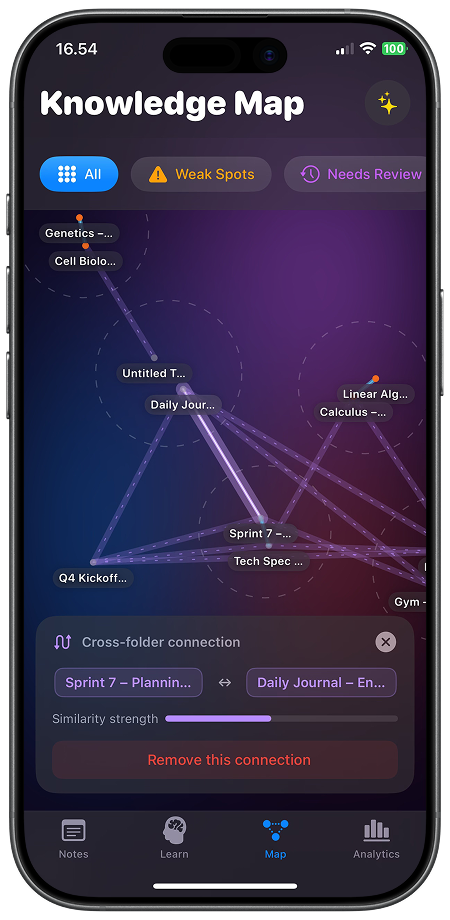
If memory is a network, your study tool should look like one. This is where knowledge mapping changes the game. Instead of a list, picture your understanding laid out as a visual map. Every idea is a node. Every relationship is a line. Dense clusters show where you’re strong. Isolated nodes show exactly where you’re thin.
Additionally, a good knowledge map surfaces links you didn’t know existed. Ideas you stored separately turn out to be connected. Concepts from one area suddenly explain something in another. This is where real insight happens — not in linear review, but in seeing patterns. Indeed, research from Novak and Cañas at IHMC shows that knowing how things relate — not just what they are — is what separates people who apply knowledge from people who can only recite it.
A Practical Framework: From Dead Notes to Live Understanding
Rebuilding your study system doesn’t need to be a big project. First, capture without worrying about structure. Write the note. Upload the file. Trying to organize everything from the start is one of the main reasons people quit note-taking. After all, you can’t build a network from notes you never wrote.
Second, let a system surface what’s gone quiet. You won’t remember which notes need a revisit. That’s not your fault — it’s just how memory works. Something outside your head must track this and bring ideas back before they fade. Third, when you revisit — retrieve, don’t re-read. Close the note first. Try to recall it from memory. Then open it. The gap between what you remembered and what was actually there is exactly what your brain needs to learn.
Fourth, map rather than file. Ask where each idea connects, what it conflicts with, and what someone needs to know before they can understand it. These questions turn dead knowledge into living knowledge. Fifth, go back to where you struggle. Not to the easy topics — to the ones you keep getting wrong. Difficulty is a signal worth following, not a reason to skip.
What This Looks Like in Practice
This is the exact problem that Wisen was built to solve. Rather than storing notes, it works as a full learning system. The difference between a note sitting in a folder and one that’s part of your active knowledge — that’s what Wisen is designed around. The echo system tracks notes that have gone quiet. It brings them back into your study loop as a gentle nudge, not a blunt alert. Study sessions are built on content you’ve actually added. As a result, retrieval practice ties directly to what you know and where you struggle.
Furthermore, the knowledge map does what it says. As you add content, it builds automatically. As your understanding grows, it updates. At any point, it shows you the shape of what you know — and the gaps you still need to fill. None of that is complicated. Good learning science, applied every day, is all it takes.
The Right Question to Ask
Most people who want to study better ask: “What’s the best way to take notes?” However, that’s the wrong question. The right one is: “What does a system look like that forces ideas to connect, catches what I’ve forgotten, and targets exactly where I’m weakest?” No easy answer exists. But a clear direction does — away from the filing cabinet, toward the network. Your memory isn’t failing you. It’s just waiting for the right structure.
Leave a Reply