

Learning & Knowledge Systems · April 2026 · 13 min read
Note-taking is one of the most common learning habits in the world.
Students take notes in lectures. Professionals write meeting notes. Researchers collect ideas. Creators store insights.
However, a surprising problem appears over time.
Most notes are never used again.
People write thousands of notes across notebooks, documents, and digital tools. Yet weeks later they struggle to remember what they wrote.
This is why many people start searching for better note-taking methods, better digital note-taking apps, and better knowledge management systems.
But the real problem is deeper.
Most note-taking tools focus on storing information. Very few help people learn, remember, and connect knowledge.
This guide explains how modern note-taking systems actually work. More importantly, it shows how to transform simple notes into an active knowledge system that helps you think, remember, and learn.
“The goal of note-taking is not to collect information. The goal is to build understanding.”
Modern research in learning science
Quick Summary: How to Turn Notes Into Knowledge
If you want to improve your learning and memory, it helps to understand one key idea. Taking notes alone is not enough. Instead, knowledge grows when notes are revisited, connected, and actively used.
- Traditional note-taking stores information but rarely improves memory.
- Active learning methods like spaced repetition and active recall strengthen knowledge.
- Modern knowledge systems connect ideas instead of storing isolated notes.
- Tools such as Wisen turn notes into active learning sessions.
- The future of note-taking focuses on knowledge engagement, not information storage.
- Why Traditional Note-Taking Often Fails
- The Hidden Problem With Most Note-Taking Apps
- The Science of Learning From Notes
- The 5 Most Effective Note-Taking Methods
- Best Note-Taking Apps and Knowledge Systems in 2026
- From Notes to an Active Knowledge System
- What Is Personal Knowledge Management?
- A Simple System to Turn Notes Into Real Knowledge
- How Wisen Turns Notes Into Knowledge
- The Future of Note-Taking Is Active Knowledge
- Frequently Asked Questions About Note-Taking
Why Traditional Note-Taking Often Fails
At first glance, note-taking seems simple.
You read something. You write it down. Later you return to the notes when needed.
However, this process rarely leads to strong knowledge retention.
In fact, research in learning science and cognitive psychology shows that most notes become passive storage.
- lecture notes
- meeting summaries
- book highlights
- saved articles
- PDF annotations
Over time these notes accumulate into huge collections.
Yet they rarely become real knowledge.
Many people experience what experts call the archive problem.
Notes are saved. However, they are rarely revisited. As a result, the knowledge slowly disappears.
The Hidden Problem With Most Note-Taking Apps
Modern digital note-taking tools are extremely powerful.
Apps like Notion, Evernote, and Obsidian allow users to organize thousands of notes.
However, organization alone does not create learning.
Most note apps are designed as information storage systems, not learning systems.
| Traditional Note Apps | Active Knowledge Systems |
|---|---|
| Store information | Help you remember information |
| Organize notes | Analyze knowledge |
| Manual review | Automatic reminders |
| Static documents | Dynamic learning process |
Therefore, even the best digital note-taking methods still leave users with a problem.
The notes exist.
But the knowledge inside them slowly fades.
The Science of Learning From Notes
Modern research in cognitive psychology shows that learning works best when information becomes active.
Instead of repeatedly reading notes, the brain needs to retrieve, connect, and revisit knowledge.
Several powerful learning techniques support this process.
- active recall
- spaced repetition
- knowledge connections
- self-testing
Studies published in Psychological Science and the National Library of Medicine show that these techniques dramatically improve long-term knowledge retention.
The 5 Most Effective Note-Taking Methods
Over the years, researchers and educators have developed several structured note-taking methods.
Each method tries to solve the same problem: how to turn information into knowledge.
1. The Cornell Note-Taking Method
The Cornell method divides notes into three sections.
- main notes
- questions or cues
- summary
This method encourages review and reflection. However, it still requires manual revisiting of notes.
2. The Zettelkasten Method
The Zettelkasten method focuses on linking ideas.
Instead of isolated notes, knowledge becomes a network of connected thoughts.
This method inspired many modern personal knowledge management systems.
3. Mind Mapping
Mind maps visualize relationships between concepts.
Because the brain naturally processes connections, this method improves comprehension.
4. The Second Brain System
The Second Brain approach focuses on capturing and organizing knowledge digitally.
It emphasizes saving ideas, resources, and insights for later use.
However, many second brain systems still struggle with knowledge recall.
5. Active Knowledge Systems
A newer approach combines note-taking with learning science.
Instead of static notes, the system actively helps you learn from your own information.
This is where modern tools like Wisen introduce a new concept: the active knowledge system.
Best Note-Taking Apps and Knowledge Systems in 2026
Choosing the right note-taking system can dramatically influence how well you learn and remember information.
Some tools focus on organization. Others focus on writing. A few newer platforms focus on learning and knowledge development.
Below is a simplified comparison of popular digital note-taking tools and emerging knowledge systems.
| Tool | Main Focus | Best For | Limitations |
|---|---|---|---|
| Notion | Workspace organization | Teams and documentation | Limited learning features |
| Evernote | Digital notebooks | Simple note storage | Weak knowledge connections |
| Obsidian | Linked notes | Knowledge graph enthusiasts | Manual learning process |
| Roam Research | Networked thinking | Research workflows | Complex for beginners |
| Wisen | Active knowledge system | Learning, memory, knowledge growth | Designed primarily for knowledge engagement |
Most note-taking apps are designed to help users organize information.
However, tools like Wisen focus on something different.
They help users actively interact with knowledge rather than simply storing it.
From Notes to an Active Knowledge System
Traditional note-taking focuses on writing information down.
An active knowledge system goes further.
It helps you:
- capture information
- connect ideas
- review knowledge
- identify weak points
- revisit important concepts
In other words, the system becomes a learning partner rather than a storage tool.
What Is Personal Knowledge Management?
Personal knowledge management, often called PKM, is the practice of collecting, organizing, and using knowledge effectively.
Instead of letting information disappear, people build systems that help them think and learn.
A good personal knowledge management system usually includes several elements.
- information capture
- note organization
- idea connections
- knowledge review
- long-term learning
This concept has become extremely popular among researchers, creators, and professionals.
However, many PKM systems still require manual effort to maintain.
This is why newer platforms focus on automation, knowledge analysis, and AI learning assistance.
Tools like Wisen expand the idea of PKM into a full learning system.
Instead of static notes, the system analyzes information, highlights connections, and helps users revisit important ideas.
A Simple System to Turn Notes Into Real Knowledge
Fortunately, improving your note-taking system does not require complex workflows. Instead, a few simple habits can dramatically increase how much you remember.
Step 1: Capture Ideas Clearly
First, focus on capturing the core idea rather than copying full paragraphs. Writing concepts in your own words forces the brain to process information actively.
Step 2: Connect Notes to Other Ideas
Next, connect new notes to existing knowledge. When ideas link together, they form a network that is much easier to remember.
Step 3: Revisit Notes Over Time
Then, review important notes periodically. Spaced repetition strengthens memory and prevents knowledge from fading.
Step 4: Test Your Understanding
Finally, challenge yourself with questions. Self-testing forces the brain to retrieve knowledge, which greatly improves retention.
How Wisen Turns Notes Into Knowledge
Wisen was designed as a learning system rather than a traditional note-taking app.
The goal is simple.
Instead of collecting static notes, users build a living knowledge system.
Your notes should evolve with your knowledge.
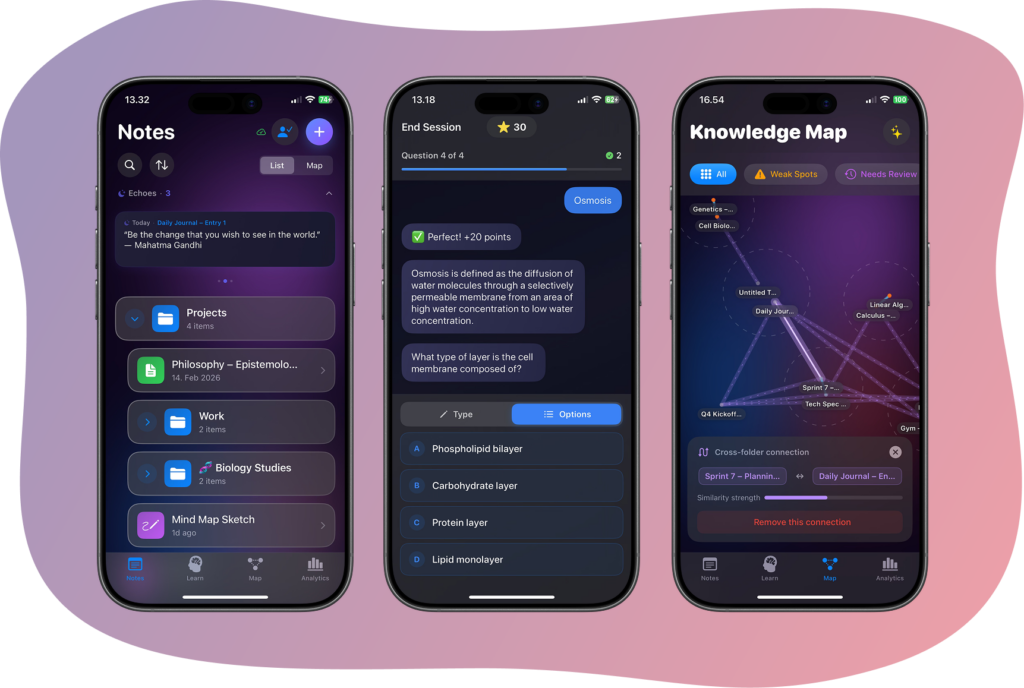
Convert Any Information Into Notes
Users can transform almost any type of information into notes.
- documents
- PDF files
- photos of slides
- handwritten notes
- audio recordings
The system converts and organizes the information automatically.
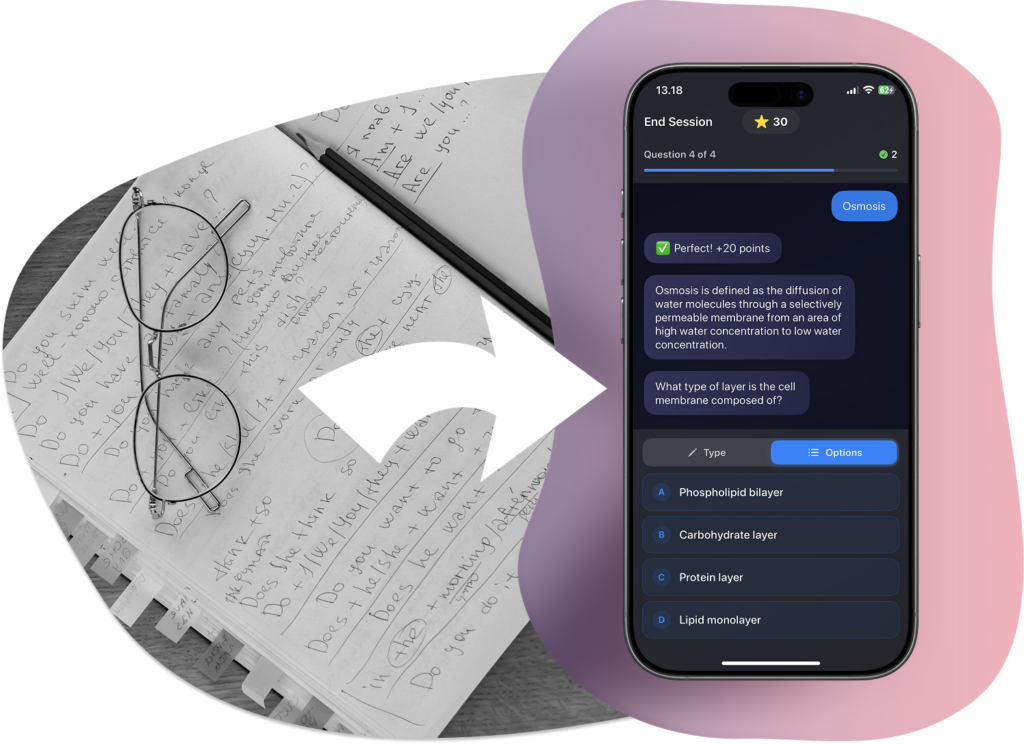
AI-Powered Learning Sessions
Wisen analyzes your notes and generates personalized study sessions.
The AI identifies weak points and suggests questions at the right time.
This approach combines active recall with spaced repetition.
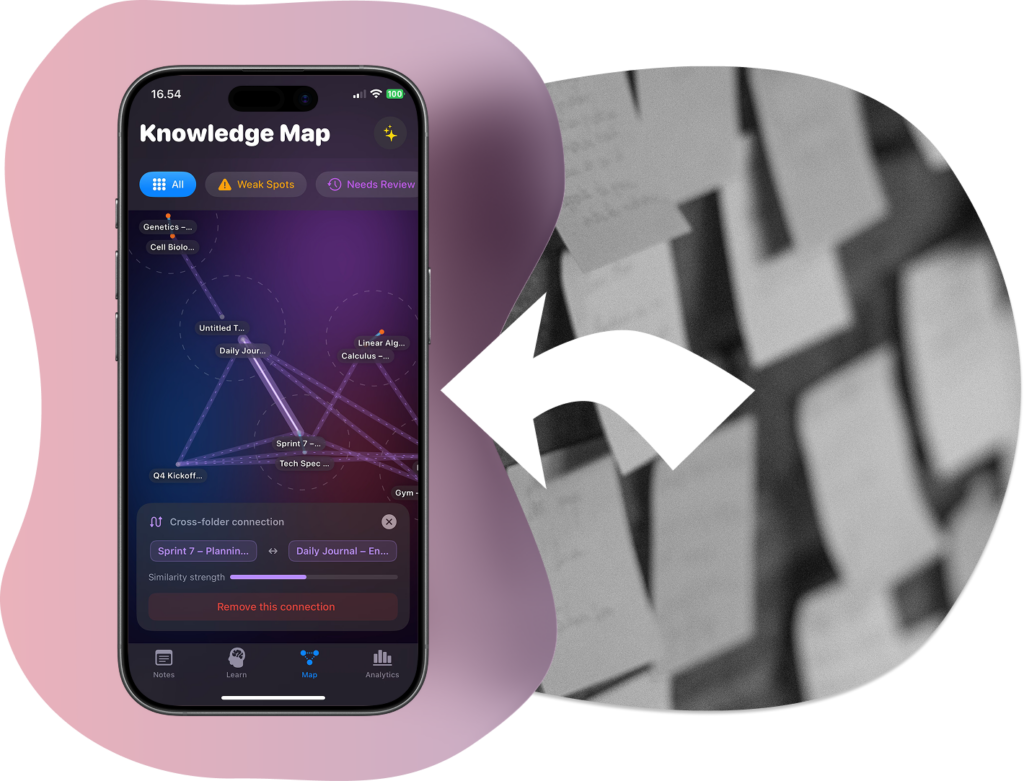
Knowledge Maps
The system also builds an automatic knowledge map.
This visual network shows connections between ideas across your notes.
As a result, knowledge becomes easier to navigate and understand.
Gentle Reminders and Knowledge Echoes
Not every note needs to be studied intensely.
Some information only needs occasional reminders.
Wisen uses gentle reminders and knowledge echoes to bring important notes back when needed.
This keeps your knowledge fresh without overwhelming study sessions.
The Future of Note-Taking Is Active Knowledge
The world is producing more information than ever before.
However, simply saving information is no longer enough.
The real challenge is turning information into usable knowledge.
This is why the future of note-taking, personal knowledge management, and learning systems is shifting toward active knowledge systems.
Systems that do not just store ideas.
But help you think with them.
And remember them when it matters most.
Frequently Asked Questions About Note-Taking
What is note-taking?
Note-taking is the process of capturing and organizing information for future reference.
Students often take lecture notes. Professionals record meeting notes. Researchers store insights from books and papers.
Modern note-taking systems also support knowledge management, helping people organize ideas and build understanding over time.
What is the best note-taking method?
The best note-taking method depends on the purpose of the notes.
- The Cornell method works well for structured lecture notes.
- The Zettelkasten method supports research and idea development.
- Mind maps help visualize complex concepts.
- Active knowledge systems help users learn from notes over time.
Increasingly, people combine these approaches inside digital knowledge systems.
How can I take notes more effectively?
Effective note-taking focuses on understanding rather than copying information.
- write ideas in your own words
- connect related concepts
- review important notes later
- test your knowledge using questions
These techniques improve knowledge retention and deeper learning.
What is digital note-taking?
Digital note-taking refers to capturing information using software rather than paper notebooks.
Digital systems allow users to organize notes, search information quickly, and connect ideas across large knowledge collections.
Some modern platforms also include AI learning tools and knowledge analysis.
Leave a Reply